Grief and Loss
The Five Stages of Grief?
The stages of grief have been a topic of debate in grief counseling since their introduction in 1969 by Elisabeth Kubler-Ross, in her book “On Death and Dying”. These stages of grief can be loosely described as a cycle of emotions that humans can expect to feel, resulting from some type of unexpected loss. Grief and loss is very normal process, and something most people will be forced to cope with at some point in their lives. However, to categorize each person’s feelings into an arbitrary set of stages would not be realistic.
In general, the five stages of grief are described as Denial, Anger, Bargaining, Depression, and Acceptance. The bereavement community has been quick to accept and assign grief in stages, most likely to lend a sense of hope to those who are grieving and might feel this is an endless proposition. In that regard, the five stages of grief are extremely helpful because they reaffirm the fact that grief is normal, and has been experienced and resolved successfully by countless people.
Although these stages of grief appear somewhat simple, it is doubtful that most people will ascend through them as they are laid out. That is the danger of the existence of these type of scales. Offering someone who is grieving the idea that their emotions can be corralled into five equal stages of grief, and that in time they will successfully complete a stage and move onto the next one, can put an extreme amount of undue pressure on an individual.
It should be pointed out that there is no right or wrong way to grieve. Further, the types of emotional reactions and behaviors that people exhibit as a result of loss will differ depending upon the type of loss they have suffered. Mourning over a relationship breakup can produce grief, but it will be much different than the grief and loss experienced from the loss a child.
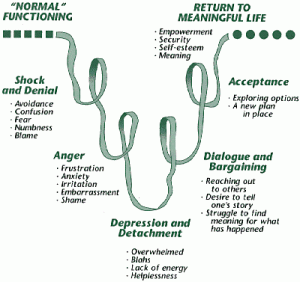
Below are the Five Stages of Grief:
1. Denial – The first stage of grief is Denial. It is really the first of our reactions to any form of sudden loss. Depending on the relationship we share to the subject of our loss, the more our lives may be uprooted or altered. It is very common for people to try and initially deny the event in order to subconsciously avoid sadness, or the thought of pending mental struggles. People in denial often withdraw from their normal social behavior and become isolated. Denial has no set time frame, or may never be felt at all. However, it is considered the first stage of grief.
2. Anger – The second stage of grief is Anger. People that are grieving often become upset with the person or situation which put them in their grief state. After all, their life could now be in complete disarray. The path of least resistance is anger as opposed to facing the consequences of a loss head on. In the case of death, the anger is often focused toward the deceased for leaving that person behind and unable to cope. Other times people become angry at themselves if they feel they could have done something more to stop the loss from happening.
3. Bargaining – The third stage of grief is Bargaining. This is when those who are grieving are reaching out to the universe to make the pain go away. It is actually very normal, and largely considered to be a sign that they are beginning to comprehend their situation. People will often try to make a deal, or promise to do anything, if the pain will be taken away.
4. Depression – The fourth stage of grief is Depression. Contrary to popular belief, depression is something that may take some time to develop. We often think we are depressed when a grief event first occurs, but there is usually a lot of shock and other emotions present before any real depression can set in. The signs of depression due to grief usually appear when a sense of finality is realized. This is not to be confused with clinical depression, which may be chronic. Depression due to grief is technically episodic, even though it may last for a lengthy period of time.
5. Acceptance – The fifth stage of grief is Acceptance. This is the point where the person experiencing grief no longer is looking backward to try and recover the life they once had with the deceased, or other cause of their grief episode. It is not to say that they no longer feel the vast array of emotions brought on by their grief, but they are ready to embrace the idea that they are reaching a new point in there lives. At this point, they are beginning to understand that there is a new beginning on the horizon.
Acceptance should not be confused with healing or recovering from the loss, since that would put an enormous amount of pressure on people experiencing grief. Acceptance is really the beginning of the real healing process. It is the point where recovery becomes about the person left behind, and not about the person being mourned.
Unfortunately, There’s No Simple Answer
The stages of grief should not be taken as a literal guide to healing or ascending through grief, because in reality, life does not fit into such perfect stages. Most people and their grief episodes are different, so recovery is usually not as simple as posting a few stages on the refrigerator and hoping you will quickly move from one to the other.
In fact, many grief counselors and psychologists debate the effectiveness of the stage theory, and often wonder if the idea can be counterproductive. Our nature suggest that arranging the expectations of what we may feel during perceived hopeless situations may serve to provide a “light at the end of the tunnel” scenario. However, applying this to extreme episodic grief due to loss is not always a path to success.
An persons emotions and reactions to grief may run the gamut of each stage, but it is doubtful each will arrive at the gateway of the next stage with all aspects of the previous stage completed. Also, there is no guarantee that anyone shall arrive to any of the stages of grief in chronological order, nor should they be expected to display behaviors associated with one stage at a time. There is simply no reasonable expectation to assume that any one person will naturally adhere to this formula without psychological coaxing.
However, the five stages of grief do provide an excellent guide for grief support, as well as assessing the condition and mental state of patients through relating them to a chart of commonalities. The most important part of recovering from grief, especially bereavement, is to seek out help and realize that grief is normal and fully expected. There is no shame in grieving or mourning, even for extended periods of time. Simply referring to the five stages of grief, and the debate about how they relate to the grieving process, should help reaffirm the notion that feeling grief is completely normal. It also requires attention and action on the part of those who are suffering in order to effectively heal.
Additional Information About Grief and Loss:
Grief Message Boards
Loss of a Child
Loss of a Parent
Loss of a Pet
Loss of a Sibling
Loss of a Spouse